Natural Light and Dementia Care: Why Outdoor Time Helps
Key Highlights
- Light is the main signal the body uses to tell day from night, and dementia damages the part of the brain that reads that signal.
- Ordinary indoor lighting is far dimmer than most people assume, often too dim to register as daytime at all.
- More daylight tends to improve nighttime sleep, reduce daytime dozing, and soften late-day agitation and sundowning.
- Going outside adds things light alone cannot: movement, balance, appetite, and sensory engagement that does not depend on memory.
- Outdoor time often reaches people who no longer respond to structured activities, because it asks nothing of their recall.
- Outdoor access quietly disappears in many care settings because of fall worries, weather, and staffing, and the cost of that loss is rarely counted.
- Safe outdoor time is mostly logistics: timing, shade, footwear, hydration, glare control, and an enclosed space with no dead ends.
- When families tour a community, how it handles outdoor access in February tells them more than how the courtyard looks in June.
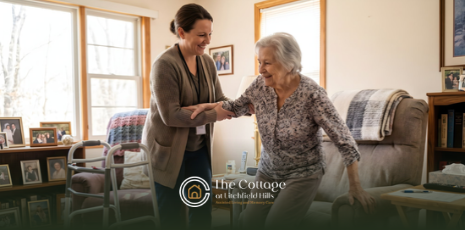
Ask a care team what changed on the day a resident finally slept through the night, and the answer is frequently something small and unglamorous. Breakfast moved to the sunroom. The afternoon walk became a standing part of the day instead of an occasional treat. Someone took her coffee out to the patio at nine in the morning rather than drinking it in a dim living room.
Outdoor time and daylight are among the few things in dementia care that cost almost nothing, carry very little risk when done sensibly, and touch sleep, mood, appetite, behavior, and quality of life all at once. They are also among the first things to quietly drop off a daily routine, and once they are gone, nobody connects the harder evenings to the fact that the person has not been outside in three weeks.
This is how light and outdoor time actually work in dementia, what to expect, and how to build both into a day safely.
Light Is How the Body Knows What Time It Is
Every person has an internal clock that governs when they feel alert, when they get hungry, when hormones shift, and when they get sleepy. That clock does not run accurately on its own. It has to be reset daily, and the strongest thing that resets it is light reaching the eye.
Three things make this harder with age and dementia.
First, the eye changes. The lens yellows and the pupil admits less light, so an older adult sitting in the same room as a younger visitor is receiving noticeably less light at the retina. Cataracts, macular degeneration, and glaucoma reduce it further.
Second, dementia damages the clock itself. The small region of the brain that keeps circadian time is affected in Alzheimer's disease and other dementias. The timekeeper becomes less reliable at exactly the stage of life when the signals reaching it are getting weaker.
Third, daily life stops supplying cues. Fewer errands, fewer outings, less work, fewer social commitments, more hours seated indoors. The whole scaffolding that used to anchor the day to a schedule thins out.
The result is a clock that drifts. Day and night blur, naps stretch longer, nights fragment, and late afternoon becomes the hardest part of the day.
Indoor Light Is Dimmer Than It Feels
This is the part that surprises families most. Human vision adapts so well that a room can feel perfectly bright while delivering a fraction of the light the body needs as a daytime signal. The numbers are not close.
| Where the person is sitting | Roughly how bright | What the body clock makes of it |
|---|---|---|
| Living room with lamps on in the evening | About 50 to 200 lux | Reads as night, which is appropriate after dark and a problem at noon |
| Well-lit room or office during the day | About 300 to 500 lux | Fine for reading, a weak signal for the clock |
| Chair pulled up beside a sunny window | Roughly 1,000 to 5,000 lux | A real daytime signal, no coat required |
| Outside on a gray overcast day | Roughly 1,000 to 10,000 lux | Stronger than almost any indoor space, even without sunshine |
| Outside in open daylight | 10,000 lux and well above | The strongest everyday cue the clock ever gets |
Two practical conclusions follow. A cloudy winter day outdoors still beats a bright living room by a wide margin, so "it is too gray to bother" is almost never true. And where someone sits matters as much as how long they sit there. Moving a favorite chair to within a few feet of a window, so the person faces the light rather than away from it, changes their daily light exposure more than most interventions a family will ever try.
What More Daylight Tends to Change
- Nighttime sleep. This is the effect families notice first. A day with real morning light and a dim, quiet evening gives the clock a clear contrast to work with. A day spent in uniform indoor lighting gives it almost nothing, and the night that follows is often broken.
- Daytime dozing. Long afternoon naps and poor nights feed each other. Bright mornings and some physical activity break that loop from the daytime side, which is usually easier than trying to fix the night directly.
- Sundowning. Late-day confusion and agitation are worse in dim, shadowy rooms, and worse again in winter when dusk arrives early. Strong daylight earlier in the day, plus turning lights on before the light fades rather than after, smooths the transition that so often sets off the late afternoon.
- Mood. Depression is common in dementia and frequently missed. Getting outside reliably lifts mood in a way that is visible within minutes, even when nobody can explain exactly why.
- Appetite and strength. Fresh air and movement stimulate appetite, which matters a great deal in a population at real risk of weight loss. Sunlight also supports vitamin D, which matters for bone strength and fall recovery.
What the research does and does not show
It is worth being straight about the evidence, because marketing in this field often is not. Formal clinical trials of light box therapy in dementia have produced mixed and generally disappointing results, and major systematic reviews have concluded there is not enough evidence to recommend light boxes as a treatment. Reviews of ambient bright light, meaning brighter living spaces rather than a device someone sits in front of, have been more encouraging, particularly for depressive symptoms and agitation.
The mechanism, meanwhile, is not in question. Light is how the circadian system is set, that system is demonstrably disrupted in dementia, and older adults in care settings typically receive very little bright light.
So the honest framing is this. Daily outdoor time and well-lit living spaces are sensible, low-risk, well-founded care that many people respond to noticeably. They are not a treatment for dementia and nobody should present them as one. And if you are considering a light therapy device specifically, talk to the physician first, since there are real reasons for caution with certain eye conditions, bipolar disorder, and medications that increase light sensitivity.
What Going Outside Adds That Light Alone Cannot
If light were the whole story, a bright window seat would be enough. It is not, because stepping outside delivers several other things at the same time.
Movement with a purpose.
A walk outdoors involves uneven ground, slopes, turns, and distance, which does more for strength and balance than a hallway loop. Better balance is the long game in fall prevention, and it is worth remembering that keeping someone seated to prevent falls tends, over months, to produce exactly the weakness that causes them.
Engagement that asks nothing of memory.
This is the part families underestimate. Most structured activities carry a quiet demand: remember the rules, recall the word, know the answer, recognize the face. Being outdoors makes no such demand. Wind, birdsong, sun on the skin, the smell of cut grass, the texture of a leaf, a dog going by on the sidewalk. There is no wrong answer available, so there is no failure available either. People who have stopped participating in organized programs often remain fully present outdoors.
An outlet for the drive to move.
A great deal of what gets labeled agitation is a person who needs to be in motion with nowhere acceptable to go. Pacing a corridor is that drive hitting a wall. A safe, enclosed path with somewhere to arrive turns the same restlessness into a walk, and care teams frequently report that scheduled outdoor time takes the pressure out of the afternoon.
Identity and the things the hands remember.
Procedural memory and long-term memory last longer than recent recall. A person who spent forty years gardening may be unable to say what month it is and still know exactly how to pinch back a tomato plant and firm soil around a seedling. Handing someone a task their hands remember restores competence in a way no amount of reassurance can, and it is one of the most reliable sources of genuine pride still available to them.
Easier visits.
Families often dread visits because conversation is hard and silences feel like evidence of loss. Walking side by side removes the obligation to talk and supplies something to look at and comment on. Grandchildren who are uneasy in a sitting room are usually fine in a garden. Many families find that outdoor visits are the ones that still feel like time together rather than an appointment.
Fewer behaviors that look like crises.
None of this is a prescription, but the pattern is consistent across settings: people who get outside daily sleep better, eat better, and have fewer of the hard late-day episodes that otherwise lead to more medication and more distress for everyone.
Why Outdoor Time Quietly Disappears
Almost nobody decides to stop taking someone outside. It erodes.
There is one stumble on the patio, and outdoor time stops while everyone recovers their nerve, and then it never restarts. A courtyard exists but has no shade, no loop, and nowhere to arrive, so nobody uses it. The door stays locked because the garden is not actually secure. Taking one unsteady person out requires a staff member for twenty minutes, and on a short-staffed morning that is the first thing to go. Someone says no once, and the offer is never repeated. The weather is bad for a week, and the habit is lost.
None of this shows up as a problem on any chart. The worse sleep, the flatter mood, the harder afternoons: those show up, but they get attributed to the dementia progressing. Which is why outdoor time has to be somebody's actual responsibility and a fixed part of the daily schedule, not a nice idea for pleasant days.
How to Do It Safely and Actually Keep Doing It
- Make it routine, not an event. Attach it to something that already happens every day. Coffee on the porch after breakfast. A walk after lunch. Fifteen or twenty minutes daily does more than an hour once a week, and a fixed time means nobody has to decide.
- Invite, do not ask. "Do you want to go outside?" is easy to decline. "Come help me check on the tomatoes" or "Walk with me, I need the company" works far better, because it offers a purpose and a role rather than a proposal to evaluate.
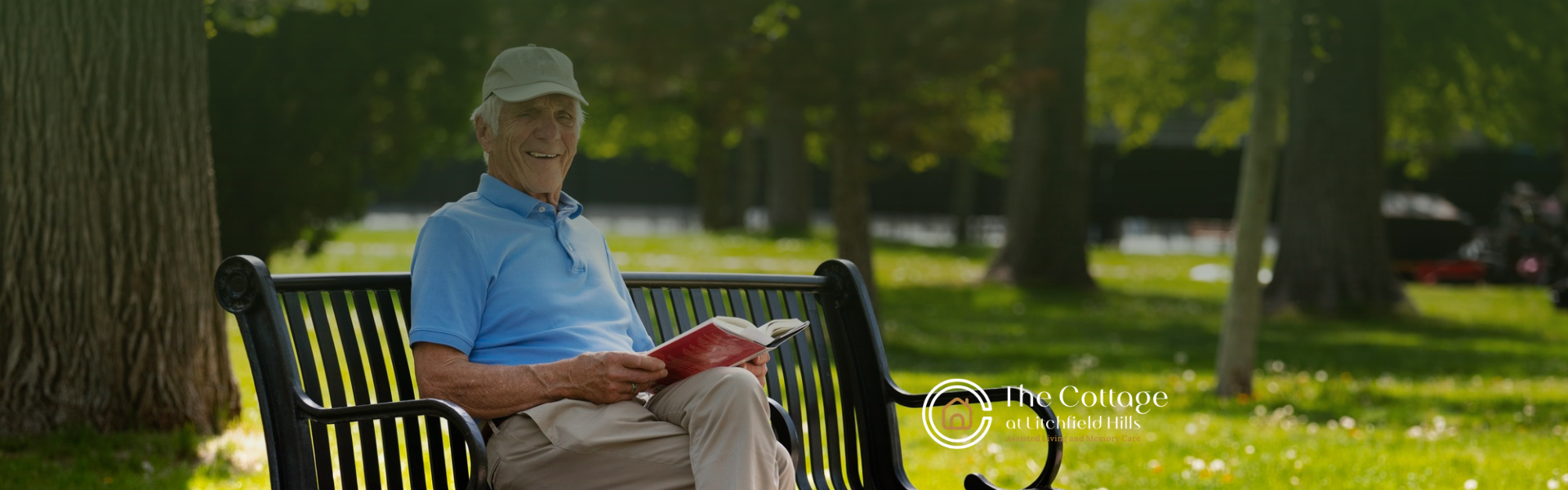
- Go when the light is useful. Morning light is the most valuable for the body clock, so mid-morning is often the ideal slot. In summer, go before the heat; in winter, go near midday.
- Watch what the eyes are doing. This is specific to dementia and frequently missed. Harsh shadows falling across a walkway can read as a hole or a step and stop a person cold. Dappled light on pavement can look like scattered objects. Dark doormats can look like openings in the ground. Glare off wet concrete or a glass door is genuinely disorienting. Favor even, matte surfaces, go when the shadows are less severe, and use a hat brim to cut glare if sunglasses feel strange to them.
- Handle the basics every time. Shoes with real tread and no open backs. Layers rather than one heavy coat. Water, because thirst signals are unreliable. Sunscreen and a hat. A check on whether any medication increases sun sensitivity. A bench or two along the route, since the walk back is the part that gets underestimated.
- Let the space do some of the work. The best outdoor spaces for dementia share a few features: a continuous loop rather than dead ends, because a dead end creates distress and a loop always brings a person back; seating at intervals; a visible destination such as a bird feeder, a fountain, or raised planting beds; secure fencing softened by plantings so it does not read as a barrier; level, even paths; shade; and nothing toxic within reach.
- Be honest about supervision. Someone unsteady on their feet or inclined to head for the road needs a companion, and that is a staffing question rather than a reason to keep the doors shut. The right answer is accompanied outdoor time, not no outdoor time.
| Season | Best window | What to watch for |
|---|---|---|
| Spring | Mid-morning | Mud and wet grass underfoot, pollen, chilly breezes that are easy to underdress for |
| Summer | Before 10am or after 4pm | Heat and dehydration, sunburn, medications that raise sun sensitivity |
| Fall | Late morning to early afternoon | Wet leaves are genuinely slippery, and darkness arrives earlier than people expect |
| Winter | Around midday | Ice, wind chill, and the fact that someone with dementia may not register being cold; keep trips short and layered |
On a week when going outside truly is not safe, do not simply cancel it. Move the same slot indoors: breakfast at the brightest table, a chair turned toward the window, a sunroom, a walk past a wall of glass. The routine is what you are protecting.
What We See in Practice
One resident taught our team more about this than any article could.
She arrived withdrawn. She declined every activity we offered, took most meals in her room, and spoke very little. Her family was discouraged, and the early notes were the kind that make everyone brace for decline. What changed things was a passing remark from her son during a care conversation: his mother had kept a vegetable garden behind the house for close to forty years, and had grown most of what the family ate in the summer.
So we did not invite her to an activity. We asked for her help. We had a raised bed that needed planting, and we brought her out one morning with tomato and basil seedlings and a watering can and admitted we were not sure how deep to put them.
She corrected us within about a minute. She showed us how deep, how to firm the soil around the stem, and why we had the spacing wrong. She came out the next morning without being asked, and the morning after that. Within a few weeks she had taken over the bed completely, had started telling another resident what he was doing wrong with the peppers, and was eating lunch in the dining room because that was where the conversation about the garden was happening. Her sleep improved. Her appetite improved. Nothing about her medications changed.
She could not have told you what day it was. Her hands knew exactly what they were doing, and being outside with a job to do gave her back something that sitting in a bright room never would have.
We have seen the lighter version of this many times too. A gentleman whose nights were badly inverted started having breakfast at the sunroom table instead of in his apartment, with a standing walk after lunch. Three weeks later the overnight staff noticed he had stopped getting up at two in the morning. That is the whole intervention: light earlier, movement daily, same time every day.
What Families Should Ask When They Tour
If outdoor access matters to you, and it should, these questions reveal far more than a pretty courtyard photographed in June.
- Is there a secure outdoor space residents can use freely, and is that door unlocked right now?
- Is outdoor time on the daily schedule, and whose job is it to make sure it happens?
- How often does the average resident actually get outside in January?
- What happens after a fall? Does outdoor time stop, and for how long?
- Does the path form a loop, and is there shade and seating along it?
- Are the common rooms genuinely bright during the day, and are chairs placed facing the windows?
- What is the plan during a stretch of rain or ice?
Then ask to walk the outdoor space yourself, ideally in the late morning. An empty courtyard on a beautiful day tells you something important.
Light, Air, and a Reason to Go Outside
Natural light and dementia care belong together for reasons that are easy to explain and easy to forget in a busy week. Light tells the body what time it is, and dementia makes that message harder to receive. Going outside delivers the light and adds movement, appetite, calm, sensory pleasure that asks nothing of memory, and the kind of purposeful task that reminds a person what they are still capable of. None of it cures anything. All of it makes the day better, and better days are the point.
That belief shapes how we build a day at The Cottage at Litchfield Hills. Daily outdoor time is part of the schedule rather than a fair-weather extra, our secure outdoor space is designed for safe independent walking, our common areas are kept bright with seating placed to face the light, and our team is trained to ask about a resident's history and habits so that time outside comes with a purpose that means something to that person. Based in Torrington, we serve families throughout Litchfield County and the surrounding Connecticut communities, and we are always glad to talk with families who are early in this process.
If you would like to see what thoughtful, daylight-filled memory care looks like in practice, please contact us today to schedule a tour. Come in the late morning, and we will walk the grounds with you.
Frequently Asked Questions
How much outdoor time does someone with dementia need?
There is no official number, but fifteen to thirty minutes a day is a sensible goal, and morning is the most valuable slot because that is when light does the most to set the body clock. Consistency beats duration. Twenty minutes every day will do more for sleep and mood than two hours on Sunday. Five minutes on the porch still counts, and on hard days it is the right target.
Does it still help on a gray day or in the middle of winter?
Yes, and this surprises people. Outdoor light on an overcast day is still far stronger than the light in a well-lit room, so the body clock gets a real signal even with no sun visible. Winter needs more preparation rather than less commitment: shorter trips, proper layers, careful footing, and attention to the fact that a person with dementia may not recognize or report being cold.
My parent refuses to go outside. What should I do?
Change the offer rather than repeating it. Give them a purpose and a role: help with the bird feeder, keep me company, look at what the neighbors did to their porch. Try sitting instead of walking, try a different door, try a different time of day, and try again tomorrow, since one refusal is not a decision. Also check for a reason: pain, fear of falling, feeling cold, needing the bathroom, embarrassment about being seen, or vision changes that make steps and shadows frightening. A fixed daily habit is also much easier to maintain than a decision made fresh each time.
Is outdoor time safe if they are unsteady or inclined to wander?
With planning, usually yes. That means a companion, a secure enclosed space with a loop and no dead ends, good footwear, a route with seating, and sensible timing. It is worth weighing the real risks of staying in as well: weakness, worse sleep, low mood, and more late-day agitation. The goal is managed access, not elimination.
Do light therapy lamps work for dementia?
The evidence for light box devices is mixed, and major reviews have found it insufficient to recommend them as a treatment. Brighter ambient lighting throughout the living space looks more promising, especially for mood and agitation. If you want to try a device, ask the physician first, because there are genuine cautions with some eye conditions, bipolar disorder, and light-sensitizing medications. Real daylight remains the better place to start, and it is free.
Sources:
- https://www.alz.org/help-support/caregiving/stages-behaviors/sleep-issues-sundowning
- https://pmc.ncbi.nlm.nih.gov/articles/PMC6779159/
- https://alzfdn.org/dementia-changes-visual-impairment/
- https://www.healthline.com/health/alzheimers-dementia/dementia-eyes-look-different


Other articles you might like